In/Out/Of
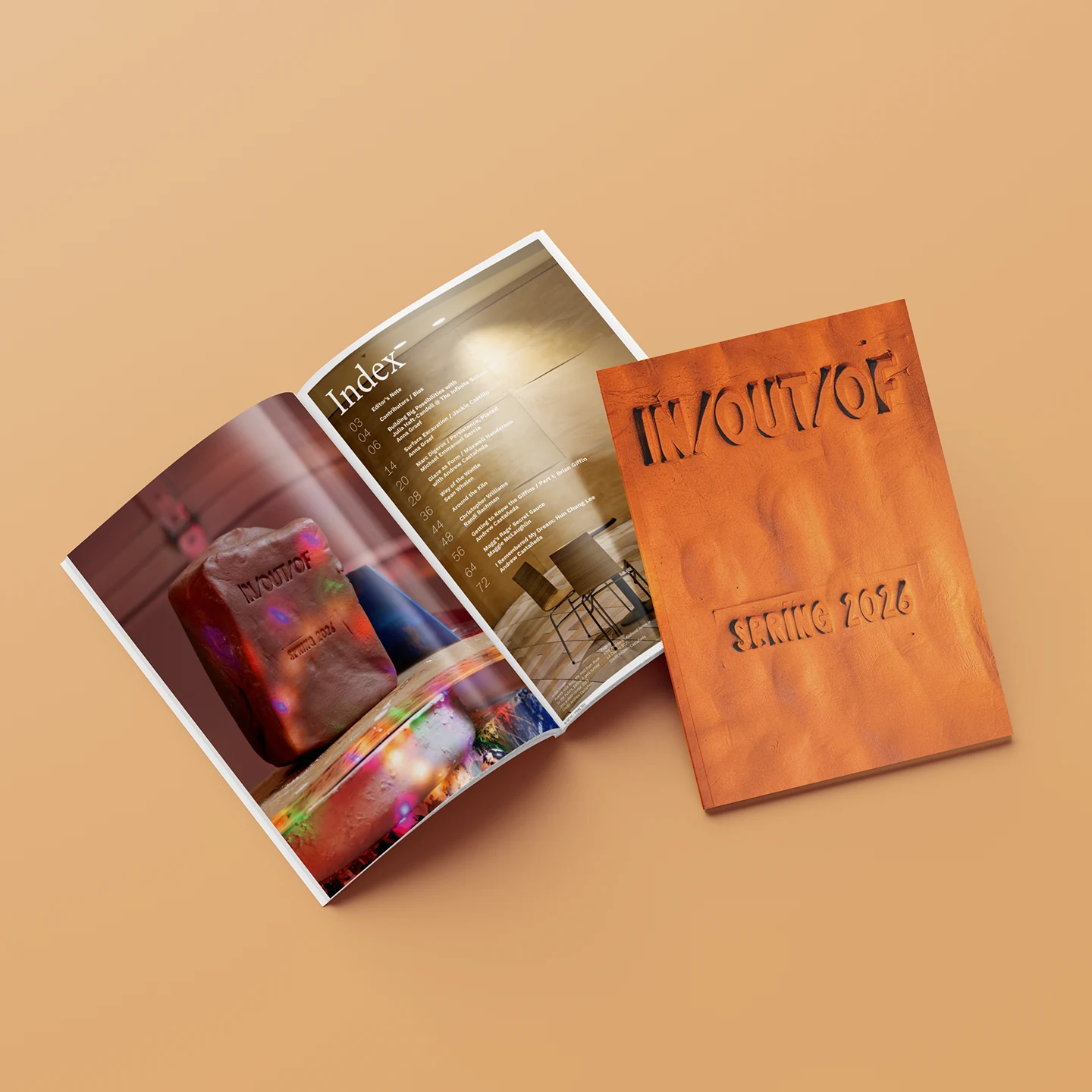
Vol. 2, No. 1
Spring 2026
Out of stock
Contents
- Building Big Possibilities with Julia Haft-Candell @ The Infinite School
- Surface Excavation
- Persistence, Placed
- Glaze as Form
- Way of the Wattle
- Christopher Williams
- Around the Kiln
- Getting to Know the Giffins / Part I: Brian Giffin
- Magg’s Rags’ Secret Sauce
- I Remembered My Dream: Hun Chung Lee
Editor’s Note
When you love something, for me, it’s about loving all of something, not just the parts you see yourself in. This was something I learned first hand in the medium of ceramics. In an early ceramic class, we had an assignment where we had to investigate and critique the work of artist Ehren Tool. As I was just getting into ceramics at community college, I didn’t grasp what he was really doing. I thought, “This dude just makes cups? No bowls or platters, no vases? What was this guy doing?” This was the ceramics my professor wanted us to look at?” This was coming from my place of limited understanding of ceramics and its lexicon, my lack of understanding what I was seeing. Anyway, I turned in my assignment and forgot about the whole thing.
About a year later, having moved from California, I was in my second semester as a newly-transferred ceramics student at the Kansas City Art Institute, and I was working at the Nelson-Atkins Museum of Art across the street. My friend Jad and I were assigned from KCAI’s ceramics department to assist artists in the Nelson-Atkins’ NCECA show “Unconventional Clay: Engaged In Change.” Our responsibilities ranged from meeting and greeting the artists, to driving them and touring them around the city, to assisting artists with anything they needed during their programs at the museum, and finishing and firing the work they made there.
One of the artists selected for the exhibition was Ehren Tool. He put on an event at the museum, drawing in the local community for a lecture and demonstration. Ehren, a veteran himself, had asked curator Catherine Futter to invite veterans and people who had lost loved ones in tragic ways to sit in conversation with him while he worked at the wheel and talked. Participants brought photos of their loved ones, which Jad and I later decaled onto the cups Ehren made that day. The cups were exhibited in the museum show, and then participants were invited to take home the cup with their photo at the end of the exhibition.
Participants were moved to tears while speaking with Ehren; I was astonished. All the while, Ehren was throwing cup after cup off the hump. Once he got down to the bottom of the hump, Ehren wedged another 25lbs of clay into the museum’s floor, then loaded that onto the wheel and continued throwing cups. The emotion I saw that day was palpable and inescapable. Ehren had gathered a lot of hurt people together, and offered healing conversation. At the end of the event, Ehren had made about 300 cups. I was finally able to understand the meaning Ehren imbues into his ceramics works, which live in homes all over the place. To this day, I’ve never seen a plate, bowl, or vase do what Ehren and his cups do.
After the program was over, we took Ehren out for some burgers and beers. He was visibly exhausted from the day’s event, having listened to countless people share their own traumatic stories. I told him how much I appreciated his visit and program. He’d opened my eyes to see that ceramics could be a vessel for narrative and connection at any stage, even before vitrification.
Eventually, after enough beer, I told Ehren about the school assignment years earlier, where I’d written that I thought he should be making more than just cups. But after experiencing him work that weekend, I reevaluated my original judgement of his work. It was eye opening to see that despite a humble cup form being at its center, Ehren’s work is incredibly expansive in scope and reach. I’d written it off because I didn’t see what I wanted, rather than making any effort to understand what he was doing. It was easy. We often laugh at things we don’t understand, dismissing them too easily. Looking back, the joke was on me. After telling Ehren how he’d enlightened me that day, he smiled and gave me the biggest hug. That day was quite profound for me. Sometimes, when life wants you to understand a lesson, it shows up right in front of you.
As I considered how to fill this issue of In/Out/Of, I wanted to showcase expansion through passion, how desires become roads and ideas become vehicles. I wanted to draw focus to artists who are building lives and careers using ceramics methodologies in innovative and interesting ways, including but also beyond the physical works they make. I thought about artists who use potentially-conventional ‘building blocks’ in unconventional ways, remixing both knowledge and material in new contexts, expanding our field.
It’s not easy work, but these artists approach uphill battles with determination and grace. With resilience and essential belief in themselves, they figure out how to support their endeavors, and how their endeavors can support them in return. Each expands ceramics in their own direction.
Each of these artists have a love for ceramics, as a material and beyond. Ceramics is so much wider than conventions or histories might suggest. And it continues to expand; widening Ceramics is part of all of these artists’ work, opening possibilities for others to do the same, and go even further. I see something in each of them that reflects the way Ehren Tool’s work so formatively cracked open my own understanding of Ceramics.